.png?width=150&height=81&name=Houghton%20Contracting%20Logotype%20New%20Logo%20(1).png)
23 Min Read
Remodeling a kitchen is an exciting project, but figuring out how to pay for a kitchen remodel can be daunting. Kitchen renovations are among the most expensive home improvements, so it's crucial to plan your budget and financing carefully.
By understanding typical costs, creating a solid budget, and exploring kitchen remodel financing options, you can transform your kitchen without stress over money. This guide will walk you through cost expectations, budgeting steps, financing methods (A–F), and strategies to keep a budget-friendly kitchen remodel on track.
A kitchen remodel can modernize your home and boost its value, but it comes with a hefty price tag.
Many homeowners spend tens of thousands on new cabinets, appliances, countertops, and labor. Without a plan, costs can spiral and lead to financial strain. The key to a successful remodel without stress is smart budgeting and financing. This means understanding how much your project might cost, setting a realistic budget (with a cushion for surprises), and choosing the right way to pay, whether from savings or via financing.
In this article, we'll cover the full process: from cost overview and how to budget for a kitchen remodel, to detailed kitchen remodel financing options, to tips for keeping your renovation on budget. By the end, you'll know exactly how to pay for a kitchen remodel in a way that suits your financial situation, so you can enjoy your dream kitchen worry-free.
Cost Overview
Kitchen remodel costs vary widely based on the scope and quality of the project. National surveys show that the median cost of a kitchen remodel is around $22,000 as of recent years. In other words, half of kitchen projects cost less than that, and half cost more.
Many modest "budget-friendly" kitchen remodel projects (especially DIY-oriented or cosmetic updates) can come in well under this figure, one industry report found homeowners typically spend about $11,600 on a kitchen remodel on average (including DIY projects). On the higher end, a major kitchen overhaul with new custom cabinets, structural changes, high-end appliances, and professional installation can easily run $30,000–$50,000 or more. In fact, luxury kitchen remodels can reach $90,000 to $150,000 in some cases.
Several factors influence where your remodel will fall on this spectrum:
- Size and Scope: A small facelift (painting cabinets, new hardware, lighting) might be done for a few thousand dollars, whereas gutting a large kitchen and rebuilding it will cost far more.
- Materials and Finishes: High-end cabinetry, stone countertops, and professional-grade appliances dramatically increase costs. More affordable options like stock cabinets, laminate counters, or mid-range appliances can cut costs.
- Labor and Structural Changes: Labor often comprises 20–35% of the budget. If you keep the same layout (avoiding moving plumbing or walls) and do some work yourself, you save on labor. Structural changes or hiring a general contractor add to costs.
- Home Value Level: Experts recommend your kitchen budget be in proportion to your home's value, commonly 15–20% of the home value. For example, a $300,000 house might warrant a kitchen renovation budget of around $45,000–$60,000. Spending much beyond that could mean you're unlikely to recoup the extra cost at resale. Conversely, investing too little (under 5% of home value) might not have as much impact. It's about finding a sensible range for your situation.
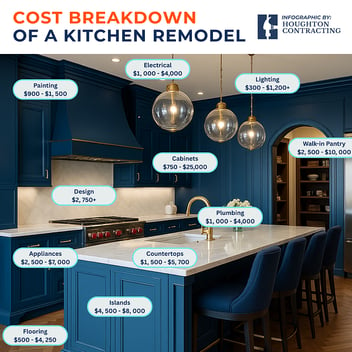
It's also important to know which parts of the project eat up the most money. Generally, cabinetry is the single largest expense in a kitchen remodel, typically about 30% of the budget on average. After cabinets, other big-ticket items include labor/installation (around 17%), appliances (14%), and countertops (10%).
Flooring, lighting, plumbing fixtures, paint, and design fees make up smaller percentages. Knowing this breakdown helps you identify where to splurge or save. For instance, if you can reuse or refresh your cabinets instead of replacing them, you stand to save a huge chunk of the total cost.
Bottom line: A realistic kitchen remodel budget can range from a few thousand to over $50K depending on your choices. Research the going costs in your area (get contractor estimates or use remodeling cost guides) and use rules-of-thumb (like the home value percentage) to ballpark a figure. Once you have a target budget, you can move on to planning how to meet it.
Table of Contents
- Budget Planning Steps
- Financing Options (A–F with Pros, Cons & Use Cases)
- Choosing the Right Option
- Smart Budgeting Strategies
- Can You Remodel for <$10K or <$20K?
- FAQs
Budget Planning Steps
Proper planning is essential to budget for a kitchen remodel effectively. Breaking the process into clear steps will help ensure you cover all bases and keep your spending on track. Below are key budget-planning steps:
- Identify Needs vs. Wants: Start by defining the goals for your kitchen remodel. What problems are you trying to solve? What features are must-haves (e.g. fixing a failing floor or adding more counter space) and what items are merely nice-to-have? Prioritize the necessary improvements over cosmetic or luxury add-ons. This helps allocate funds to the most important areas first. For example, replacing an old oven that doesn't work would be a "need," while a built-in wine fridge might be a "want."
- Determine What You Can Afford: Take a hard look at your finances to set the maximum budget. Figure out how much you have in savings for this project and how much you might need to finance. A spending plan or budget worksheet can help evaluate your income, expenses, and how much you can put toward renovation costs.
Do you have savings earmarked for home improvements? If not, will you fund this with cash, a loan, or other credit? Also consider any competing financial goals, for instance, don't sacrifice your emergency fund or retirement contributions entirely for a new kitchen. It's wise to decide on a comfortable budget range before you start getting quotes or shopping, to avoid committing to more than you can handle.
- Define the Remodel's Purpose: Are you renovating primarily for your own long-term enjoyment, or to boost resale value in the near future? The answer can influence your budget approach. If you plan to sell in a couple years, you might set a tighter budget (e.g. closer to 10% of home value) and choose neutral, cost-effective upgrades with broad appeal.
If this is your forever home, you might justify spending a bit more on personalized features or higher-quality materials that you'll enjoy for years (even if they aren't the highest ROI items). Clarifying the purpose helps align your spending with your objectives.
- Research Costs and Create an Itemized Budget: Once you know your overall budget limit, break it down by project components. List out all the elements of the remodel (cabinets, counters, appliances, flooring, paint, electrical, plumbing, labor, etc.) and gather cost estimates for each. You can get quotes from contractors or use online cost estimators to get in the ballpark.
Don't forget to include "soft" costs like design fees, permit fees (if any), and taxes on purchases. This step is essentially drafting a budget breakdown that assigns dollar amounts to each category. If the initial total overshoots your budget, consider trimming the scope or opting for more affordable materials until the numbers align.
- Decide DIY vs. Contractor: Determine which parts of the project you will hire professionals for and which (if any) you can do yourself. Labor is a major cost component, so sweat equity can yield savings if you have the skills. For example, doing your own demolition, painting, or installing backsplash tile could save you labor charges. However, be honest about your abilities, electrical, plumbing, or cabinet installations done incorrectly can cost more to fix.
If you do hire a contractor, plan to get multiple bids for the work. Comparing at least 2–3 quotes can ensure you're getting a fair price and help refine your budget assumptions. Remember, the lowest bid isn't always best, consider the contractor's reputation and included scope.
- Build in a Contingency (Emergency Fund): One of the smartest budgeting strategies is to expect the unexpected. Almost every remodel uncovers surprises, from hidden water damage to last-minute design changes, that can increase costs. Set aside a healthy reserve, typically 10–20% of your budget for contingencies. In fact, the National Kitchen and Bath Association (NKBA) suggests after you determine your budget, set aside an extra 25% as a cushion to cover surprises and prevent stress. For example, on a $20,000 budget, earmark at least $4,000 for unforeseen expenses. If you end up not needing it all, great, you come in under budget. But if something does go wrong, you won't be scrambling for funds. Budgeting high for emergencies means if you come in under budget, you'll feel great, and if not, you're prepared.
- Finalize the Budget and Plan Financing: At this point, you should have a detailed budget and a clear idea of costs. Double-check that the total (including the contingency) is covered by the money you have or the financing you plan to obtain. Don't proceed with signing contracts or starting demolition until your financing is secured (whether it's a loan approval or liquid cash set aside). Knowing the money is in place will give you peace of mind to move forward. In the next section, we'll explore the various how to pay for a kitchen remodel options (A–F) to fund the budget you've established.
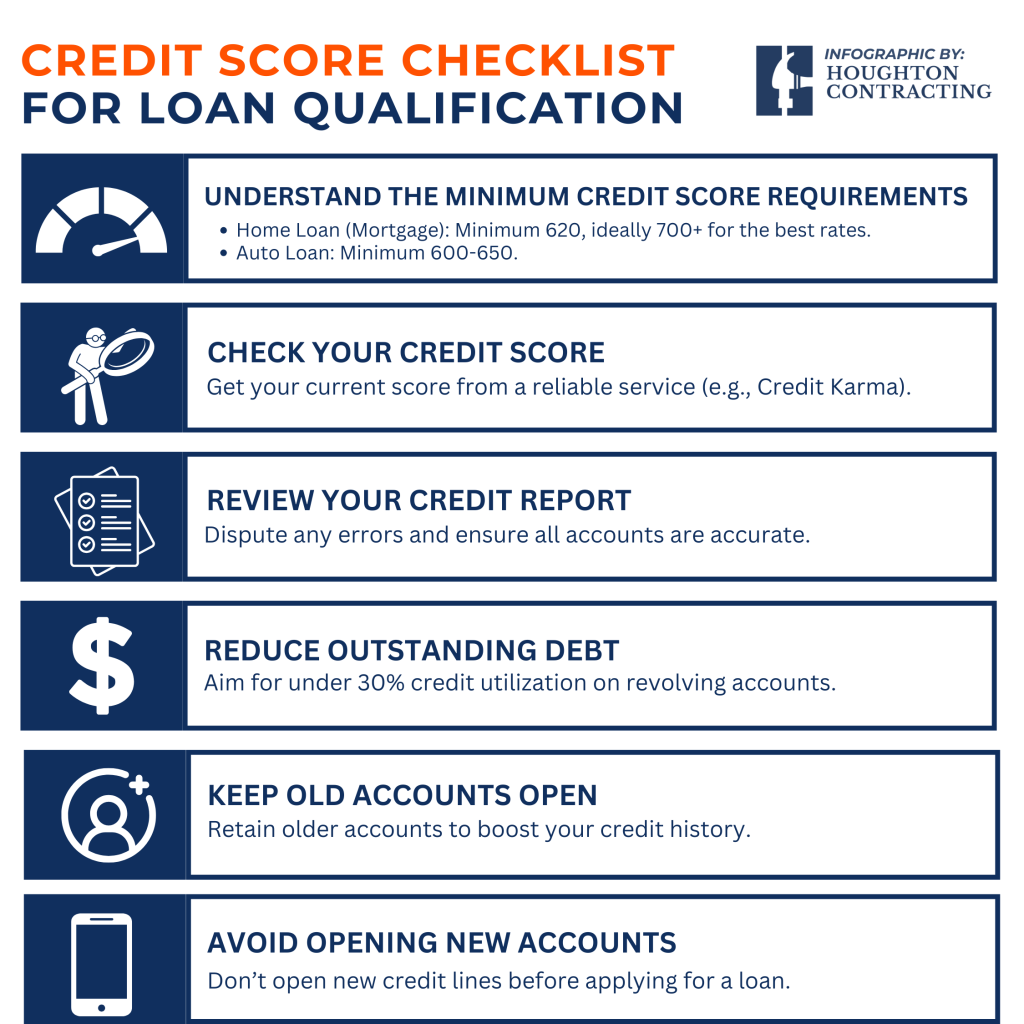
Here's a free Credit Score Checklist for Loan Qualification to help you stay on track as you prepare for your loan application! This checklist will guide you through the key steps to ensure your credit score is in the best shape possible before you apply.
Financing Options (A–F with Pros, Cons & Use Cases)
If you're like most homeowners, you may not have cash on hand to pay for a full remodel. The good news is yes, you can finance a kitchen remodel, and there are multiple options to consider. Below are six common financing methods (A–F), each with advantages, disadvantages, and ideal scenarios. The right choice depends on your financial situation (savings, home equity, credit, etc.) and the size of your project.
Comparison of major kitchen remodel financing options (cash, home equity loan, HELOC, cash-out refi, personal loan, credit card) with their pros, cons, and ideal use cases.
A. Cash / Savings (Paying Out-of-Pocket): The simplest way to fund a remodel is to use your savings. Paying cash is the thriftiest method because you avoid interest charges entirely. This means the total cost of your project is lower than if you borrowed money and paid interest over time. Using cash also keeps you debt-free, you'll own your renovated kitchen outright. However, the obvious downside is that you must have enough savings available.
Tapping your savings might deplete your emergency funds, leaving you less cushion for other needs. It's important not to drain accounts that are earmarked for true emergencies. Best for: relatively small upgrades or mid-range remodels that you can comfortably pay for from savings. If you've been planning and putting aside money for this project, using cash will ultimately be cheapest and least stressful. Just be sure to leave yourself a financial safety net.
B. Home Equity Loan (Second Mortgage): A home equity loan allows you to borrow against the equity (ownership) you've built in your home. It's essentially a second mortgage: you receive a lump-sum loan, typically at a fixed interest rate with steady monthly payments. Home equity loans are a popular way to finance large renovation projects because their interest rates are usually much lower than unsecured loans or credit cards (since your house is collateral). They also can be repaid over a long term (often 5–15 years), making monthly payments more affordable.
Most people choose a fixed-rate home equity loan for one-time remodel projects that have a known cost, as it provides certainty of payment. Pros: Relatively low interest; predictable payments; you get all the funds upfront to pay contractors and suppliers. Cons: You need sufficient equity in your home to qualify, lenders typically require that total mortgage debt (existing mortgage + new loan) not exceed about 75–80% of your home's value. If you bought your home recently with a small down payment, this could limit how much you can borrow. Also, you're putting a lien on your home, meaning failure to repay could lead to foreclosure (you're using your house as collateral).
There are also closing costs for the loan, and you'll now have two mortgage payments. Best for: One-time mid- to large-scale remodels when you have equity and want a fixed monthly payment. If you're comfortable using your home as collateral and have a steady income to make the payments, a home equity loan can finance a kitchen remodel at a reasonable cost.
C. Home Equity Line of Credit (HELOC): A HELOC is another way to tap home equity, but instead of a lump sum, it works like a credit line that you can draw from as needed. Think of it as a credit card secured by your house. During an initial draw period (say 10 years), you can borrow multiple times up to your approved limit, useful if your remodel will be done in stages or if you want flexibility. You pay interest only on the amount you actually use. Pros: Extremely flexible, you can borrow gradually, which is great for a long renovation or if you're not sure exactly how much you'll need. You can also reuse the line (borrow, repay, borrow again) without reapplying.
HELOC interest rates are often variable and tied to prime rate, which initially might be low. Cons: That variable interest means your rate and monthly payment can change (and likely rise) over time. If interest rates increase, the cost of your kitchen remodel financing increases, potentially straining your budget. Many HELOCs are interest-only during the draw period, which keeps payments low at first but can lead to a large balloon payment later when principal comes due. Essentially, if you only pay interest for years, at the end of the term you still owe the entire principal, you must either pay it off in a lump sum or start a repayment plan, which can be a shock if not prepared.
As with a home equity loan, your home is collateral, so missing payments could put your house at risk. Best for: Longer or uncertain projects where you need funds over time or want an emergency cushion. For example, if you're doing a DIY remodel gradually, a HELOC allows you to borrow for each phase. It's also useful if you want to finance a kitchen remodel and keep flexibility, just discipline yourself to pay down principal to avoid the big balloon. Consider converting to a fixed-rate loan later if possible to lock in the interest.
D. Cash-Out Refinance: A cash-out refinance replaces your existing mortgage with a new, larger mortgage, and you take the difference in cash to use for your remodel. Essentially, you refinance your home loan but "cash out" some of your equity in the process. This can provide a large sum at the relatively low interest rate of a primary mortgage (often lower than a second mortgage or personal loan). Pros: You consolidate your debt into one mortgage payment and potentially spread the remodel cost over 15–30 years, making monthly payments smaller.
If interest rates have dropped since you got your original mortgage, you could also end up with a lower rate on the whole balance. Cons: You are increasing your mortgage debt and reducing your home equity in exchange for cash. This increases your exposure if the housing market declines or if you face financial hardship. Converting unsecured debt into mortgage debt can increase the risk of foreclosure if you were unable to pay the larger mortgage. Also, if current mortgage rates are higher than your existing rate, a cash-out refi could be financially unfavorable, you'd be paying more interest on your entire mortgage balance (not just the new cash).
Don't forget closing costs here as well, which can be a few percentage points of the loan. Best for: Major remodels or additions where you need a significant sum and plan to be in the home long enough to justify refinancing. It can make sense if you can get a good mortgage rate (or if you already planned to refinance for other reasons). Always weigh the long-term cost: you might be paying off that new stove for 30 years, which isn't ideal unless the rate is very low. Use this option cautiously and consult a lender to see the full impact.
E. Personal Loan (Unsecured Home Improvement Loan): If you don't have home equity or prefer not to borrow against your house, a personal loan is an option. Many banks, credit unions, and online lenders offer unsecured home improvement loans, which are essentially personal loans marketed for renovations. These loans typically have a fixed interest rate and fixed term (e.g. 3, 5, or 7 years). Pros: No collateral is required, you don't put your home on the line.
The application process is usually quicker and simpler than a mortgage; funds can be available in days. For a moderate-sized project, a personal loan can cover the needs without complex paperwork. Cons: Interest rates will be higher than home equity loans because the loan is unsecured (depending on your credit, rates might range from maybe 6%–15%+). Also, the repayment terms are shorter than a mortgage, often under 10 years, which means higher monthly payments than you'd have on a 15- or 30-year loan. This can put a squeeze on your monthly budget if you borrow a large amount.
Loan amounts may also be capped (for example, a bank might offer up to $50,000 for a personal loan), which could be less than an extensive remodel costs. Best for: Moderate projects (perhaps $5,000–$20,000 range) for homeowners with solid credit and income but little equity. If you want to avoid touching your home equity or need funds quickly, an unsecured personal loan can fill the gap. Just be mindful of the higher interest cost, it's wise to shop around for the lowest rate or consider a secured option if you're borrowing a big sum.
F. Credit Cards: Credit cards should generally be a last-resort financing method for a remodel, given their high cost. However, they are an option in some scenarios, particularly if the amount is relatively small or you can pay it off very quickly. Pros: Using a credit card is extremely convenient for purchasing materials or paying contractors (many accept credit card payments). If you have a card with a high limit, it can cover a short-term funding gap. Some homeowners strategically open a new credit card that offers a 0% introductory APR for, say, 12–18 months and charge remodel expenses to it, planning to pay it off before the promo period ends. This can effectively finance the project interest-free for that period (essentially a same-as-cash loan), but you must be disciplined to pay it off in time. Cons: In all other cases, carrying a large balance on a credit card is very expensive.
Credit card interest rates average around 20–25% APR in recent years, much higher than any other financing option. If you only make minimum payments, you'll accrue huge interest charges and potentially take decades to pay off. It's also easy to get in over your head, unlike a loan, a credit card doesn't have a fixed repayment term, so you must impose your own payoff plan.
Maxing out cards can hurt your credit score as well. Best for: Minor upgrades or short-term financing needs that you are confident you can pay off quickly. For example, if you are $5,000 over your budget and need a few extra months to gather funds, a credit card could bridge the gap (ideally with a promotional rate). Or if your project is small enough to pay off within a year, a 0% APR card offer can work. Generally, avoid financing a large kitchen remodel on credit cards beyond the promotional period, the interest will make your project far more expensive than it needs to be.
As you can see, there are a variety of financing tools available, from using cash to taking out loans. Many homeowners end up using a combination (for instance, using savings for part of the cost and a loan for the rest). The table above summarizes these options (A–F) for easy comparison of their pros, cons, and ideal uses. Next, we'll discuss choosing the right payment option for your situation and how to approach that decision.
Choosing the Right Option
With multiple ways to finance your kitchen remodel, how do you decide which is best for you? The right choice comes down to balancing cost, risk, and your personal financial picture. Here are some guidelines to help you choose the optimal financing method:
- Maximize Low-Cost Funds: Generally, it's wise to use the cheapest money available to you. This means if you have savings that can cover the project (without jeopardizing your emergency fund), use them first because it costs nothing in interest. If you need to borrow, seek out the lowest interest option you can qualify for, often a home equity loan or refinance will have significantly lower rates than an unsecured loan or credit card. For example, instead of putting $15,000 on a credit card at ~20% APR, a home equity loan at maybe 6–8% will save you thousands in interest and provide a structured payoff plan.
- Consider Your Equity and Collateral Comfort: If you have substantial home equity, tapping it will likely yield the lowest financing rates. However, be mindful of the risk, when you borrow against your home, you're putting your house on the line. If something went wrong (job loss, etc.), secured loans could lead to foreclosure, whereas an unsecured personal loan or credit card default, while damaging, wouldn't directly cost you your home.
Ask yourself: Am I comfortable leveraging my home for this remodel? If you're not, you might lean towards unsecured financing even if the rate is higher. On the other hand, if you're confident in repayment and want the lowest rate, home equity financing is attractive. It's a personal decision about risk tolerance and security.
- Match the Tool to the Project Size: The amount you need to borrow can influence the best option. For a smaller project (say under $10,000), it might not be worth doing a refinance or opening a home equity line, a personal loan or even a 0% credit card promo could be simpler and sufficiently low-cost if paid off quickly. For a large project ($50k or more), a higher-interest personal loan would be less feasible (the payments would be very high over a short term), so using a long-term home equity loan or refinance would make more sense. The middle-range projects could potentially go either way, so weigh other factors.
- Assess Your Credit and Terms: Your credit score and debt-to-income ratio will impact what loans you qualify for. If you have excellent credit, you may get attractive offers on personal loans or credit card promotions. If your credit is weaker, you might find home equity loans easier to obtain (since they're secured by the property). Always shop around and get rate quotes for multiple options.
Sometimes lenders offer specialized home improvement loans or incentives. Also check if interest on a certain loan would be tax-deductible, for example, interest on home equity loans or refinanced mortgages used for substantial home improvements can be tax-deductible under IRS rules (consult your tax advisor). A tax deduction effectively lowers the cost of the loan.
- Plan Your Repayment: However you finance, make sure you have a clear repayment plan in your budget. Look at the monthly payment for a given loan amount and term, and ensure it's something you can comfortably handle alongside your other expenses. If you're considering a short-term financing like a credit card or 12-month loan, verify that you can pay it off in that timeframe. Avoid the mistake of only planning how to get the money and not how to pay it back. The goal is to enjoy your new kitchen without ongoing financial stress.
- Hybrid Approaches: You don't necessarily have to pick just one financing source. For example, you might pay for cabinets and appliances with savings, but finance the contractor's labor via a home equity loan. Or use a small personal loan for a portion of the project and cover the rest on a 0% credit card that you'll pay off quickly. Combining methods can give you flexibility, just be cautious not to overcomplicate or overextend yourself.
Smart Budgeting Strategies
Securing funds is only half the battle, the other half is managing your spending during the remodel to stay on budget. Cost overruns are a common source of stress. Fortunately, there are several smart budgeting strategies you can use to keep your project affordable and get the most value out of each dollar:
- Plan and Stick to the Scope: The more detailed your plan before work begins, the better your budget adherence will be. Make all key design decisions (materials, products, layout) upfront to avoid costly changes mid-project. It's often last-minute additions or upgrades ("while we're at it, let's also…" syndrome) that cause budgets to blow up. Define the scope and commit to sticking to it. If you feel tempted by an upgrade, circle back to your needs vs. wants list. Only add scope if you can truly afford it or if you're willing to cut something else.
- Shop Smart for Deals: You can shave a lot off your budget by being a savvy shopper. Look for sales or discounts on appliances (year-end closeouts, holiday sales) and consider floor models or scratch-and-dent appliances which often have minor cosmetic flaws but huge markdowns.
For cabinets and materials, comparison shop multiple suppliers. Sometimes semi-custom cabinet companies have sales or a local kitchen showroom might be clearing out a display. Also explore remnant stone yards for countertops, smaller granite or quartz pieces for a kitchen island, for instance, can be much cheaper than ordering a full slab. Every dollar saved on materials is a dollar you can allocate elsewhere or keep in your pocket.
- Retain the Same Layout: Whenever possible, avoid moving plumbing, gas lines, or walls. Keeping your existing kitchen layout means you won't incur the high costs of rerouting pipes, ducts, and electrical wiring.
Layout changes often require plumbers, electricians, or even structural engineers, expenses that add up fast. By working with the current footprint (leaving sink, appliances, etc. in their current locations), you can achieve a dramatic transformation with new finishes and fixtures without heavy reconstruction costs. In short, rearranging the kitchen layout can significantly increase costs, so do it only if the functionality gains are worth it.
- Refurbish Instead of Replace: One hallmark of a budget-friendly kitchen remodel is making the most of what you already have. For example, since new cabinets can consume ~30% of a typical remodel budget, consider alternatives to full replacement. If your cabinet boxes are in good shape, you can reface them (install new door fronts and veneer) or simply paint or refinish them for a fresh look at a fraction of the cost. Similarly, rather than tearing out all your cabinetry to change the layout, see if adding organizers or pull-out shelves can improve functionality.
Other ideas: keep existing appliances if they are working fine (maybe just replace the dishwasher front panel or stove knobs for a refresh), or keep your flooring if it's in good condition and focus on updating the countertops and backsplash. Every item you don't replace fully is money saved. Use those savings on high-impact cosmetic changes.
- Do It Yourself (Selectively): Sweat equity can stretch your budget, but it's important to be strategic. Tackle tasks you are confident in, such as demolition (removing old cabinets, pulling up old flooring), painting walls or cabinets, or installing simple fixtures like a faucet or light, to save on labor costs. DIY can save you money if you have the skills and time.
However, know your limits: mistakes in tile work or electrical installations, for instance, can be expensive to fix and may void warranties or insurance. A smart approach is to DIY the easy parts and leave the complex tasks to licensed pros. Even doing 10–15% of the work yourself can lead to notable savings.
- Get Multiple Bids and Negotiate: As mentioned earlier, always obtain a few quotes for big-ticket work. This not only helps you get a competitive price, but also gives you leverage to negotiate. If Contractor A knows you're considering other bids, they might be willing to match a lower price or value-engineer the project to fit your budget (for example, suggesting a cheaper material or a slightly different approach to cut costs).
Just ensure you're comparing apples to apples in the bids, a very low bid might have omitted something essential. You want a good price with a clear, complete scope. Also, don't hesitate to discuss with your contractor, "This is my budget, how can we achieve what I want within this number?" Experienced contractors often have ideas to reduce cost (simplifying a design detail, or doing the project in phases, etc.).
- Monitor Expenses Closely: Once the remodel is underway, keep a close eye on spending. Track all invoices and purchases against your budget categories. If one area is running over, look for savings elsewhere to offset it. It's easier to course-correct mid-project than to be surprised at the end. Have a small notebook or spreadsheet for the project and update it in real time as bills come in. This way, you'll always know where you stand and can avoid budget overruns.
- Leave a Contingency Unused if Possible: Treat your contingency fund as truly untouchable except for genuine unexpected problems. If halfway through the job you really want to splurge on a pricey faucet that wasn't in the budget, it might be tempting to dip into the contingency, but try to resist unless you've passed all the potential problem points.
That cushion is there for things like discovering rotten subfloor when you remove the old cabinets, or the need to upgrade an electrical panel to support new appliances. If you're lucky and none of those issues arise, then by all means, at the end you can use remaining contingency money for bonus upgrades or simply keep it. But don't plan to spend it from the start.
Can You Remodel for <$10K or <$20K?
You might be wondering if it's feasible to do a meaningful kitchen remodel for a lower budget, such as under $10,000 or under $20,000. The answer is yes, with careful planning, you can remodel a kitchen for $10k or $20k. The key is to scale the project to fit the budget and prioritize high-impact, lower-cost improvements. Here's what a remodel in these budget ranges might look like:
- Remodeling a Kitchen for Under $10,000: At this budget level, you're looking at a cosmetic refresh rather than a full gut renovation. You will likely keep the existing cabinets and layout, focusing on surface upgrades. For example, you could paint or refinish the cabinets and add new hardware ($500–$1,000), replace the countertops with an affordable option like laminate or butcher block ($1,500 or so), buy a new mid-range refrigerator and dishwasher (around $2,500 for both), install a new sink and faucet ($500), update light fixtures ($500), and apply a fresh coat of paint to walls ($200).
Allocate a portion for labor (for the countertop installation, plumbing hook-ups, etc.), maybe $2,000, and keep about $1,000 as contingency. This kind of makeover can dramatically change the look of your kitchen on a small budget. It won't include custom cabinetry or top-of-the-line appliances, but it can address outdated surfaces and improve functionality.
Many homeowners in this range also save money by doing some work DIY (such as demolition, painting, and even installing a backsplash themselves). By focusing on a few key upgrades (countertops, appliances, paint) and not moving plumbing or cabinets, you can absolutely achieve a refreshed kitchen under $10k. It won't be a showpiece from a luxury design magazine, but it can be clean, modern, and entirely functional.
- Remodeling a Kitchen for Under $20,000: With a ~$20k budget, you can tackle a more extensive renovation, though still likely within the kitchen's existing footprint. In addition to all the cosmetic updates mentioned for a $10k remodel, a $20k budget could potentially cover new semi-custom cabinets or professionally refacing cabinets, which might run $5,000–$8,000 for a modest-sized kitchen.
You could choose engineered stone (quartz) countertops for around $2,000. Upgrading all major appliances (fridge, range, dishwasher, microwave) could be about $4,000 for a nice but not ultra-premium package. Flooring could be replaced with quality vinyl planks or ceramic tile for maybe $1,500. With the remaining budget, you'd account for labor (hiring contractors to install cabinets, countertops, flooring, etc.) and still keep a contingency of $1,000+.
You may have to make trade-offs, for instance, if new cabinets consume a big chunk, opt for a cheaper tile backsplash or keep your existing appliances a bit longer. But generally, $20k can fund a solid mid-range kitchen remodel: new cabinets or refaced cabinets, new counters, new sink/faucet, updated lighting, fresh paint, and new appliances. It won't cover luxury custom cabinetry or knocking down walls (that would push you over-budget), but it can feel like an entirely new kitchen.
The chart below illustrates two sample budget allocations, one for a $10,000 remodel and one for a $20,000 remodel, showing how the funds might be distributed across categories:
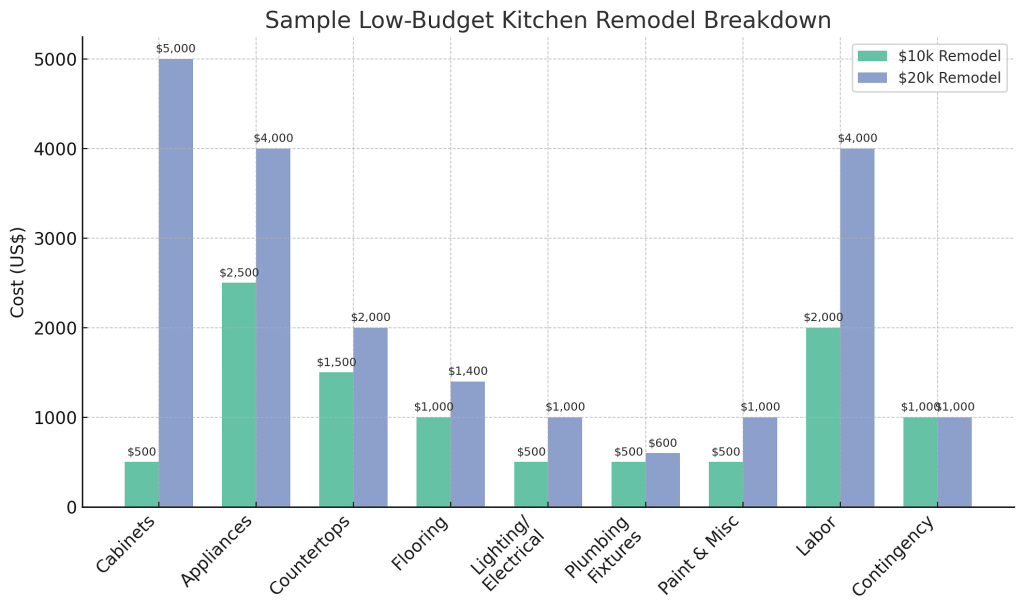
Example breakdown of a budget-friendly kitchen remodel with a total budget of $10k (green bars) vs. a more extensive remodel with a $20k budget (blue bars). Even with limited funds, focusing on key areas like appliances, counters, and paint while keeping existing cabinets can yield a significant transformation.
As shown above, in the $10k scenario, a larger share goes to appliances and essential upgrades, with cabinets retained (just improved with paint) and a modest allocation for labor and contingency. In the $20k scenario, cabinets become a major expense, along with more being spent on countertops and labor, but every category gets a boost.
These are just illustrations, your specific breakdown may differ, but they demonstrate that remodeling on a lower budget is about making conscious choices. By prioritizing the most important improvements and opting for cost-effective materials, you can absolutely revitalize your kitchen for well under the cost of a high-end renovation.
In summary, yes, you can remodel a kitchen for under $10,000 or $20,000. The result will be a refreshed space that addresses your biggest pain points, even if it doesn't have all the bells and whistles of a luxury remodel. Many homeowners actually find satisfaction in the creative challenge of remodeling within a tight budget, it leads to inventive solutions and a very high value-to-cost ratio.
Just remember that when working with a limited budget, planning and prioritization are paramount (as is a willingness to do some work yourself, if possible). If you follow the guidance in this article, you'll be well on your way to a successful budget-conscious remodel.
FAQs
Q: How much does a typical kitchen remodel cost?
Costs vary widely. In the U.S., the median kitchen remodel is around $20,000–$25,000. Minor remodels can be done for under $10,000, while major, high-end kitchen renovations can cost $50,000 or more. Your cost will depend on the size of your kitchen and the scope of improvements.
Q: How can I pay for a kitchen remodel?
You can pay with cash/savings or finance the project through options like a home equity loan, home equity line of credit (HELOC), cash-out refinance, personal home improvement loan, or even credit cards. Each financing option has pros and cons, for example, home equity loans offer lower interest rates but require equity and use your home as collateral, while personal loans are faster with no collateral but at higher rates.
Q: What is the best way to finance a kitchen remodel?
There's no one "best" way for everyone, it depends on your finances. Generally, using cash is cheapest if you have it. If not, home equity financing (loan or HELOC) tends to have the lowest interest and works well for larger projects, provided you're comfortable using your home as security. For smaller projects or if you lack equity, an unsecured personal loan or a 0% APR credit card offer (if paid off within the promotional period) can be good solutions. The best method is the one that provides needed funds at the lowest cost and risk for you.
Q: How do I keep my kitchen remodel on budget?
Careful planning and discipline are key. Set a clear budget with a contingency for surprises, and make all design decisions before you start (to avoid mid-project changes). Get multiple estimates from contractors to ensure pricing is competitive. During the project, track expenses closely. Also, incorporate cost-saving measures: keep the existing layout, reuse or refinish cabinets if possible, and tackle some DIY tasks to save labor fees. These steps will help prevent overspending.
Q: Is it possible to remodel a kitchen for $10,000 (or on a very tight budget)?
Yes, it's possible, but the project scope needs to be modest. With $10k, you'd focus on high-impact cosmetic updates like painting cabinets instead of replacing them, choosing affordable countertops, maybe upgrading one or two appliances, and doing some work yourself. It won't be a complete overhaul, but you can dramatically update the look and function of a kitchen with $10k by spending wisely. Many homeowners successfully do budget-friendly kitchen remodels in this range by prioritizing needs and finding creative, low-cost solutions.
Embarking on a kitchen remodel is a big decision, but with the right budgeting and financing approach, it can be an enjoyable and rewarding journey.
We've learned that kitchen renovations can range from minor facelifts to full luxury rebuilds, knowing the cost overview helps set realistic expectations. By following the budget planning steps (prioritizing needs, setting a budget, adding contingency, etc.), you create a strong financial foundation for your project.
When it comes to how to pay for a kitchen remodel, you have multiple smart financing options, from savings to home equity loans to personal loans, and it's about choosing the one that fits your situation best. Once the project is underway, apply smart budgeting strategies to stretch your dollars: plan thoroughly, shop deals, avoid unnecessary changes, and keep a close eye on expenses.
A kitchen remodel, large or small, is achievable without financial stress if you plan ahead. To recap: determine what you can afford, explore the kitchen remodel financing options available, and manage your spending with discipline. Whether your dream kitchen is a $5,000 refresh or a $50,000 transformation, the principles are the same.
Now that you're equipped with knowledge on how to budget for a kitchen remodel and finance it smartly, you can move forward with confidence. Here's to creating your dream kitchen, happy remodeling, and enjoy the process of cooking up something new in the heart of your home!
Need help building a budget for your kitchen remodel? Contact us today for a free quote and financing consultation.


/kitchen%20with%20double%20basin%20sink%20and%20herringbone%20tile%20backsplash%20in%20a%20houghton%20contracting%20custom%20home%20project%20in%20trenton%20new%20jersey.jpg?width=352&name=kitchen%20with%20double%20basin%20sink%20and%20herringbone%20tile%20backsplash%20in%20a%20houghton%20contracting%20custom%20home%20project%20in%20trenton%20new%20jersey.jpg)