.png?width=150&height=81&name=Houghton%20Contracting%20Logotype%20New%20Logo%20(1).png)
20 Min Read
Remodeling a kitchen is one of the most popular home improvement projects for American homeowners. The kitchen isn't just a functional space, it's the heart of the home, where families gather and daily life happens.
In fact, kitchens consistently rank as the most renovated room in U.S. homes (nearly 30% of remodel projects). Given a kitchen's central role, it's no surprise that updating this space can greatly enhance both your enjoyment of your home and its resale value.
But that leads to the big question: How much does a kitchen remodel cost in 2025?
This comprehensive guide will answer that question by breaking down current cost ranges, key cost drivers, budgeting tips, and what to expect at different project levels. We'll cover everything from national average kitchen renovation costs and cost breakdowns by component, to budgeting rules of thumb, hidden expenses to watch for, and FAQs about kitchen remodel pricing.
Whether you're planning a modest refresh or a full gourmet kitchen makeover, this guide will help you understand the average prices in 2025, how to budget wisely, and what to expect along the way.
Key Takeaways
- Average Cost in 2025: A typical kitchen remodel costs between $26,000–$45,000, with mid-range projects around $30,000.
- Cost by Kitchen Size:
- Small kitchens (<150 sq. ft): $10,000–$25,000
- Mid-size kitchens (~150–250 sq. ft): $20,000–$50,000
- Luxury kitchens (>250 sq. ft): $50,000–$100,000+
- Biggest Cost Factors: Kitchen size, layout changes, material quality, labor fees, and your location.
- Cabinets & Countertops: These are typically the most expensive elements, often consuming up to 40% of the budget.
- Budget Rule of Thumb: Spend 5–15% of your home's value on a remodel to maintain good ROI.
- Hidden Costs to Watch: Demolition, mold/asbestos remediation, code upgrades, permit fees, and surprise plumbing or electrical issues.
- $30K Remodel Tip: You can achieve a stylish, fully upgraded kitchen with a $30k budget if you prioritize smart layout, mid-range materials, and limit scope creep.
- Labor Costs: Labor often accounts for 50%–60% of the total renovation budget.
- Pro Tip: Always set aside a 10–20% contingency fund for unexpected expenses.
- ROI Consideration: Mid-range remodels may recoup 70–80% of their cost in resale value, while upscale projects recover 50–60%.
Table of Contents
- National Average Cost of a Kitchen Remodel (2025 Update)
- Major Factors That Affect Kitchen Remodel Costs
- Cost Breakdown by Component
- How Much Should You Spend on a Kitchen Remodel?
- Hidden Costs to Watch Out For
- Kitchen Remodel Cost by Kitchen Type
- Is $30,000 Enough for a Kitchen Remodel?
- FAQs (Frequently Asked Questions), Kitchen Remodel Costs 2025
- Conclusion
National Average Cost of a Kitchen Remodel (2025 Update)
When planning a kitchen renovation, it helps to start with the big picture: what does the average kitchen remodel cost in the U.S. today? Recent data indicate that in 2025, most homeowners spend somewhere between about $26,000 and $45,000 on a complete kitchen remodel.
The lower end of that range represents a typical mid-range remodel (for example, replacing cabinets, countertops, and appliances without major layout changes), while the upper end reflects more extensive projects with higher-quality finishes. For instance, one national survey reported an average kitchen remodel cost around $27,000 in early 2025.
Meanwhile, a separate remodeling industry report shows that a "kitchen upgrade" (moderate renovation) runs about $45,000 on average. In other words, a typical U.S. kitchen renovation falls in the mid five-figures. However, remember that "average" encompasses a huge variety of project sizes and scopes, individual remodels can cost significantly less or significantly more.
To put things in perspective, here's a comparison of kitchen remodel cost tiers in 2025:
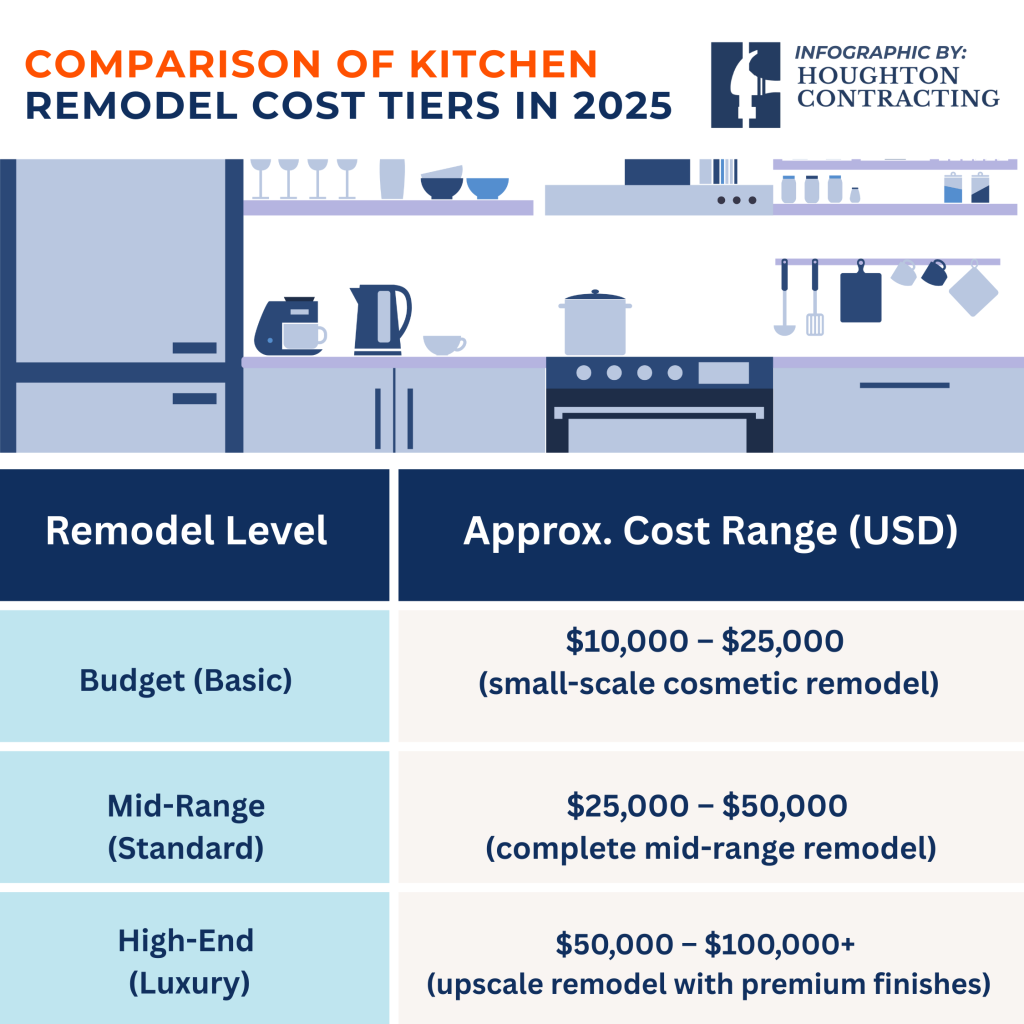
As the table shows, low-end budget kitchen remodels can start around $10–15K if you're mainly doing cosmetic updates or DIY work.
A mid-range kitchen renovation, the most common category, tends to land roughly in the $25K–$50K range for a full remodel with standard materials and professional installation.
High-end projects with luxury appliances, custom cabinetry, and possibly reconfiguring the layout will easily exceed $50K, and truly upscale kitchen makeovers can reach $80K or well into six figures
Major Factors That Affect Kitchen Remodel Costs
Every kitchen remodel is unique, and several major factors will determine where your project falls on the cost spectrum. Understanding these cost drivers can help you plan and budget more accurately. Here are the key factors that affect kitchen remodel costs:
- Kitchen Size (Square Footage): The dimensions of your kitchen directly influence cost. A larger kitchen requires more materials (cabinets, flooring, paint, etc.) and more labor hours to renovate. Contractors often estimate kitchen remodels on a per-square-foot basis, typically around $100–$250 per sq. ft depending on complexity. In short, more square footage = higher cost, so the size of your space is one of the biggest cost factors.
- Scope of Work (Project Extent): What you plan to do in the remodel has a huge impact on cost. A minor facelift (repainting cabinets, updating hardware, new light fixtures, etc.) is far cheaper than a major renovation that involves tearing out walls or relocating plumbing. If you keep the existing kitchen layout and simply replace surfaces and appliances, you avoid many costly tasks. But if you decide to change the kitchen's footprint, for example, moving the sink to a new location, removing a wall to open the kitchen to the living room, or adding an island, the costs rise quickly.
Structural modifications mean paying for demolition, possible engineering/architect fees, moving plumbing lines, re-wiring electrical circuits, and repairing floors and ceilings.
As a rule of thumb, moving infrastructure (plumbing, gas, electrical) and altering walls can be some of the most expensive aspects of a kitchen remodel. Determine early on how extensive your project will be: cosmetic refresh, pull-and-replace (new cabinets/appliances in same layout), or full redesign. The broader the scope, the higher the budget required.
- Materials and Finishes: The quality of materials and finishes you choose is another major cost variable. There is a vast price range for kitchen materials, for instance, countertop options range from inexpensive laminates at maybe $10–$40 per sq. ft up to luxury natural stones or quartzite at $100–$200+ per sq. ft
Cabinets have perhaps the biggest cost swing: you might pay a few thousand dollars for basic stock cabinets or ten times that for custom handcrafted cabinetry. Flooring, backsplash tile, lighting, fixtures, and appliances all come in budget-friendly versus high-end varieties.
As an example, opting for stock cabinets and laminate counters could keep material costs relatively low, whereas choosing custom hardwood cabinets, stone countertops, and professional-grade appliances will drive the price into the upper range.
- Labor and Contractor Fees: Hiring professionals to design and renovate the kitchen will typically account for a significant portion of the budget. Industry data shows that labor charges usually make up about 50%–60% of the total remodel cost on average.
This includes the contractor's overhead and profit, and the wages for carpenters, plumbers, electricians, painters, and other trades needed to complete the job. For a typical mid-range kitchen, labor might amount to $10K–$15K (with a comparable amount spent on materials).
Also remember that design services may add to costs, if you hire a kitchen designer or architect for plans, that could be an additional few thousand dollars (sometimes 5–10% of the project cost) unless it's bundled into a design-build contractor's services.
- Location and Regional Differences: Where you live also affects remodeling costs. There are regional cost variations in both labor and materials. For example, remodeling in a large city or affluent area (say renovating a kitchen in San Francisco, New York, or Honolulu) will generally cost more than the same project in a smaller town or rural area.
Contractors' rates, permit fees, and even material prices can be higher in high cost-of-living regions. Additionally, home styles differ, an older historic home in the Northeast might present different challenges (and costs) than a newer suburban home in the South.
- Permits and Inspections: Kitchen remodels often require building permits and inspections, especially if you are doing electrical, plumbing, or structural changes. Permit costs are set by local building departments and can range from relatively small fees to several hundred dollars.
Generally, a straightforward kitchen remodel permit might cost on the order of $50 up to $500+ depending on your city's regulations. If structural work is involved, there may be additional permit fees. While permit costs usually aren't a huge fraction of the budget, they are a necessary expense (and doing work without required permits can lead to serious complications).
Don't forget the time aspect too, obtaining permits and passing inspections can introduce some lead time and minor costs (for example, if a re-inspection is needed). It's best to have your contractor handle the permit process and include those fees in the contract. Also, factor in any specialty permits if required (for example, some areas require separate permits for electrical or plumbing work).
Cost Breakdown by Component
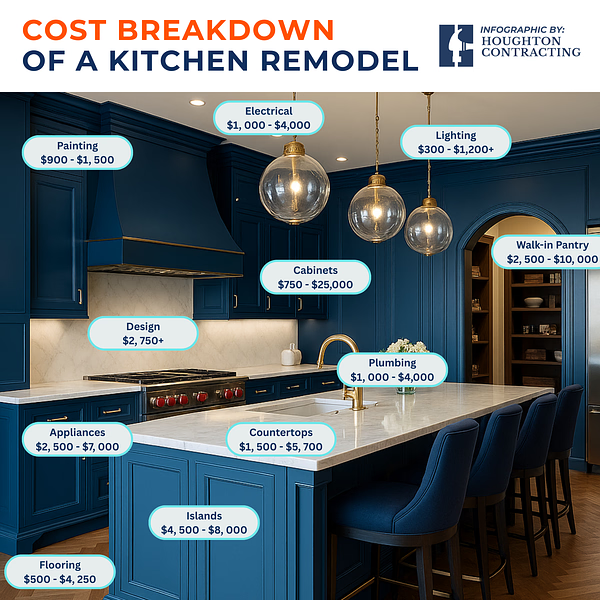
What exactly goes into the cost of a kitchen remodel? This section breaks down the typical cost by major components of the kitchen. Having a cost breakdown helps you see where your money will go, and it often reveals opportunities to save (or areas where splurging might be worth it). Each element of a kitchen (cabinets, appliances, flooring, etc.) accounts for a share of the overall budget. Below is a general overview of how costs are distributed in a kitchen renovation:
Give this Kitchen Remodel Cost Calculator a try!
As shown above, the cabinets, appliances, and countertops tend to be the most expensive line items in a full kitchen remodel, often followed by flooring and then costs related to plumbing, electrical, and lighting upgrades. Let's break down each component:
- Cabinets: Estimated cost: $5,000–$25,000+. Cabinetry is often the single largest expense in a kitchen remodel, it can eat up a significant chunk of the budget (sometimes 20-40% of the total project cost). The price range for cabinets is huge because it depends on the type and quality:
- Stock cabinets (off-the-shelf) are the cheapest, with basic stock kitchen cabinets starting as low as $100–$300 per linear foot. A full set of budget stock cabinets for a standard kitchen might be a few thousand dollars.
- Semi-custom cabinets (which allow some modifications in size/finish) are mid-tier, roughly $350–$800 per cabinet installed
- Custom cabinets (built to order, any size/feature) are the priciest, easily $500 to $1,500 per cabinet or more (which can be over $200–$500 per linear foot).
A large kitchen with high-end custom cabinetry can cost well over $20K just for the cabinets. Don't forget to account for cabinet hardware (handles, pulls, hinges), although relatively small, quality hardware for an entire kitchen can add a few hundred dollars to the cabinet cost. Given these figures, it's easy to see why cabinet upgrades are typically the most expensive part of a kitchen remodel.
- Countertops: Estimated cost: $1,500–$5,000 (for typical materials). New countertops are another major line item. The cost varies by material: for a standard kitchen with about 30 sq. ft of countertop area, you might spend around $1,500 on the low end up to $5,000+ on the high end for the counters
In contrast, popular mid-range materials like engineered quartz or granite typically cost in the range of $50–$100 per sq. ft installed, putting a typical kitchen in the ~$1,500–$3,000 range. High-end materials like marble or exotic stone can run $150+ per sq. ft, easily pushing countertop costs above $5K for a kitchen
- Appliances: Estimated cost: $2,500–$10,000 (or more). Upgrading kitchen appliances is usually a significant expense, especially if you are aiming for higher-end models. A basic suite of new appliances (refrigerator, range/oven, microwave, dishwasher) from standard consumer brands can often be purchased in the $2,500–$5,000 range total.
However, if you opt for premium or professional-grade appliances (e.g. a Sub-Zero fridge, Wolf range, etc.), the appliance budget can skyrocket, sometimes $15K or more just for those units.
According to remodeling experts, splurging on high-end luxury appliances can easily add $20,000+ for a full chef's kitchen package, whereas sticking to moderately priced models might keep the appliance spend closer to $5,000.
- Flooring: Estimated cost: $1,000–$4,000 for most kitchens. Kitchen flooring costs will depend on the material and the size of the kitchen floor area. Common kitchen flooring options include ceramic or porcelain tile, vinyl (LVP/LVT or sheet vinyl), hardwood, engineered wood, or laminate flooring. Costs can range from as low as $3–$5 per square foot for budget vinyl or laminate up to $15–$20+ per square foot for high-end hardwood or tile.
Given that the average U.S. kitchen is ~170 sq. ft, one might pay roughly $500 on the low end to around $4,000 for premium flooring materials for that area(these figures are material-only; professional installation will add labor costs unless it's a simple floating floor you DIY).
Durability and water-resistance are key for kitchen floors, so many homeowners invest in mid-range or higher-quality flooring even if it's a bit pricier, knowing it will hold up to heavy traffic and spills. Still, there are cost-effective options (like modern vinyl flooring) that can give a high-end look for less. Plan on roughly 5% of your budget (give or take) for new flooring as a starting point, and adjust based on your material choice.
- Plumbing & Electrical: Estimated cost: $1,000–$5,000 (varies widely). Upgrades to plumbing and electrical systems are often necessary in a kitchen remodel, but the cost can vary depending on the scope. If you're keeping the same layout and just swapping sinks or appliances, the plumbing/electrical costs might be fairly modest, perhaps running new supply lines for a faucet, installing new light fixtures, or adding a couple of outlets, which could be on the order of a couple thousand dollars.
However, if you're relocating the sink to a new spot (requiring new plumbing lines and drain) or adding a new gas line for a cooktop, costs go up. Rewiring the kitchen to current code (with GFCI outlets, dedicated circuits for appliances, new lighting circuits, etc.) could also add a few thousand dollars, especially in an older home where the electrical panel might need an upgrade to support modern kitchen loads. It's common for a remodel budget to allocate a few percent toward mechanical systems (plumbing, electrical, HVAC).
- Lighting: Estimated cost: $300–$1,500+. Good lighting is essential in a kitchen. The cost for lighting in a remodel will include both the fixtures themselves and the electrical labor to install them (which may be part of the electrical cost discussed above). If you're just swapping out an existing overhead light or adding a couple of pendant lights over an island, the costs might be a few hundred dollars for mid-range fixtures plus installation.
However, many kitchen remodels include a comprehensive lighting update: recessed ceiling lights (can lights), pendants or chandeliers, under-cabinet task lighting, and maybe interior cabinet lights or toe-kick lights for effect. Each of those adds cost. A single recessed light might be $100–$200 installed, for example. Decorative pendant lights can range from $50 for basic models into the hundreds for designer fixtures.
According to typical budgets, one might allocate on the order of $300 to $1,200 or more for lighting, with simpler projects at the low end and extensive layered lighting at the high end.
- Backsplash and Finishes: Estimated cost: $500–$2,500. The backsplash is a key finishing touch that protects your walls and adds style. Costs will depend on the material (ceramic tile, glass tile, stone, etc.) and the area covered. Many kitchens have about 20-30 square feet of backsplash (for instance, a 10-foot stretch of counter with 2-foot-high backsplash area).
Standard ceramic tile might cost $5–$15 per sq. ft, so materials could be just a few hundred dollars, whereas high-end mosaic or marble tile might cost $40+ per sq. ft. Including installation, a tile backsplash installation often falls in the $800 to $1,500 range for an average kitchen if using mid-range tile.
How Much Should You Spend on a Kitchen Remodel?
One of the most common questions homeowners ask is, "How much should I spend on my kitchen renovation?" There's no one-size-fits-all answer, but there are some useful rules of thumb and budgeting strategies to consider. A kitchen remodel is a significant investment in your home, and you want to spend an amount that makes sense for your financial situation and the value of your house. Here are some guidelines:
- Budget 5–15% of Your Home's Value: A widely cited rule of thumb is to invest around five to fifteen percent of your home's current market value into a kitchen remodel. Spending within this range is thought to optimize your return on investment, it improves the home without over-improving beyond what the market will support.
If you spend over 15–20%, you could be putting in far more than you'll recoup in equity (unless you simply want a luxury kitchen for your own enjoyment, which is fine too). Keep in mind this rule is a general recommendation for average situations, in a starter home, you might lean to the lower end; in a forever home or higher-end market, you might justify the higher end of the range.
- Consider the 10-20% Luxury Guideline for High-End Projects: If you are aiming for a high-end kitchen (luxury finishes, custom design), note that design professionals often say these top-tier projects will start around 10% of home value and can go up to 20% or more.
In fact, surveys of kitchen designers who cater to upscale clientele report that ultra-luxe kitchens commonly fall in the 10–20% of home value range. So, if your home is of a certain caliber and you desire a kitchen to match, your budget can be set accordingly. Just be aware that going much beyond that (say a $150k kitchen in a $500k house, which is 30%) would likely be considered over-improving, you probably wouldn't get that money back in resale value. Aligning your budget to your home's value is a good sanity check.
- Evaluate Your Finances and Goals: Rules of thumb aside, your personal budget and renovation goals ultimately determine how much you should spend. Take a close look at your finances, how much do you have saved or can afford to finance without undue stress? It's unwise to stretch beyond your means for a remodel. Set a comfortable budget range and prioritize within that. Also consider your goals for the remodel. Always balance what you want to spend with what you should spend from a financial perspective.
- Allocate Your Budget Wisely (Splurge vs. Save): Within your overall budget, decide where to splurge vs. where to save based on what matters most to you. Common advice: splurge on the permanent features that are hard to change later, for example, high-quality cabinets, durable countertops, and good appliances. These are the workhorses of the kitchen and worth investing in if your budget allows. Areas to potentially save include decorative upgrades or parts of the project that can be upgraded later with less cost.
- Build in a Contingency (10–20% extra): When setting your budget, it's strongly recommended to include a contingency reserve, typically 10% to 20% of the project cost for unexpected expenses. Remodeling projects often involve surprises, perhaps you open up walls and find old wiring that must be replaced, or you discover water damage under the old cabinets that needs repair.
There can also be small upgrades or changes you decide on during construction. Having an extra cushion in your budget will prevent those surprises from derailing the project. Planning for the "unknown unknowns" is part of how much you should expect to spend.
- Compare Costs vs. Value (ROI): It's worth considering how much of your investment you might recoup in home value. According to surveys like the Remodeling Cost vs. Value Report, a minor to mid-range kitchen remodel often recoups around 70%–80% of its cost in added home value, whereas upscale remodels recoup a bit less (maybe 50%–60%) If maximizing ROI is important, aim for a thoughtful but not over-the-top budget and choose classic, broadly appealing designs. If personal enjoyment is the goal, spend what you can afford on what will make you happiest in the space.
Hidden Costs to Watch Out For
Even the best-planned remodel can encounter hidden costs. These are expenses that homeowners don't always anticipate at the start of a project, but which often crop up once work is underway (or by the end of the project). Being aware of common hidden costs will help you budget more accurately and avoid unpleasant surprises. Here are some key potential extra costs to watch out for in a kitchen remodel:
- Demolition and Haul-Away: Removing the old kitchen is a project in itself. Many people focus on the cost of new cabinets and installation, but tearing out the old cabinets, appliances, flooring, etc., and disposing of that debris does incur costs. If your contractor's bid doesn't explicitly include demolition and trash removal, ask about it. Typically, for an average kitchen, demolition and hauling fees can range from a few hundred dollars if it's minor, up to $500–$2,000 for a complete gut-out.
- Addressing Mold, Rot, or Asbestos: Kitchens, especially in older homes, can hide issues like water damage, mold, or even asbestos in old building materials. Once the walls or floors are opened up, you might discover rotted subflooring from an old leak or mold behind sink cabinets, these issues need to be remediated before new finishes go in, adding cost.
Worse, if your home was built before the 1980s, some materials (like old vinyl flooring, insulation, or popcorn ceiling in adjacent areas) could contain asbestos. If asbestos is found, you'll need professional abatement for safety. The national average cost for asbestos removal is about $1,170–$3,120 for a project, depending on the extent
- Structural Changes and Surprises: If your remodel involves removing or modifying any walls, soffits, or structural elements, there may be hidden structural costs. For example, you might plan to remove a soffit above the old cabinets, only to find it contains vital plumbing or ductwork that must be rerouted. Or you remove a wall and then realize it was load-bearing and now needs a structural beam installed. These changes require engineer consultations, additional framing work, and sometimes permits that weren't in the original plan. But still, build some padding in your budget for structural quirks.
- Upgrades to Meet Code: When you remodel a kitchen, you typically have to bring that space up to current building codes. This can mean additional work that an older kitchen didn't have. Common examples: adding GFCI-protected outlets in all the right places, installing hardwired smoke/CO detectors nearby, upgrading the electrical panel if the load increases, or adding an outlet for a garbage disposal, etc.
- Plumbing or Electrical "Surprises": Even if you're not dramatically changing layout, you can encounter hidden plumbing or wiring issues once work begins. Perhaps the main sink drain is partially clogged or corroded and really should be replaced a few more feet into the wall, or the old wiring doesn't have a proper ground. Fixing or upgrading these while the walls are open is wise, but it does add cost.
Another common scenario is the need to upgrade the electrical panel or add a new circuit to handle additional appliances or outlets. Older homes generally have more of these hidden upgrade needs (old galvanized plumbing, undersized electrical service, etc.), whereas newer homes might have fewer. Knowing your home's age and condition can hint at what surprises might lurk.
- Permit and Inspection Costs: As mentioned earlier, permits are required for most kitchen remodels that involve electrical, plumbing, or structural work. The "hidden" aspect here is that sometimes obtaining permits or additional inspections can incur small extra costs or time delays.
Kitchen Remodel Cost by Kitchen Type
Kitchen remodel costs can also be looked at in terms of kitchen type or size category, since a small galley kitchen remodel is very different from a sprawling gourmet kitchen overhaul. Homeowners often classify their kitchen projects by size: small, mid-size, or large (luxury) kitchens. Let's examine typical cost ranges and considerations for each type, including specific examples like the commonly-referenced "10×10" kitchen remodel (a standard benchmark for kitchen size) and the slightly larger 12×12 kitchen:
- Small Kitchens (typically under 150 sq. ft), Estimated Cost: $10,000–$25,000. Small kitchens (for example, those in many apartments, condos, or smaller homes) generally cost on the lower end simply because there is less space to renovate. There are fewer cabinets, less countertop area, and often fewer appliances than an expansive kitchen.
A basic remodel of a small kitchen can sometimes be done for around $10–15K if using budget-friendly materials and keeping the layout intact. Most small kitchen remodels, however, will fall in the teens to low-20s (thousand dollars) for a complete job
- Mid-Size Kitchens (around 150–250 sq. ft), Estimated Cost: $20,000–$50,000. A mid-size kitchen in a typical single-family home (think of a kitchen that might be around 12×12 or 200 sq. ft, give or take) will have mid-range costs accordingly. There are more cabinets and counters than a tiny kitchen, but not as much as a big luxury kitchen. Many suburban home kitchens fall into this category. The national average cost for a mid-range kitchen remodel (which often corresponds to a mid-size kitchen) is in the $25K–$40K range as discussed earlier
A 12×12 kitchen (144 sq. ft) is a useful example, remodeling this size of kitchen costs roughly $20,000 on the low end up to $40,000 or more for a high-end result). One source states a 12×12 kitchen "runs between $20K and $40K" in general. If the kitchen is a bit larger (say 200 sq. ft), applying the per-square-foot costs, you might expect $30K–$50K for a full redo. Within the mid-size category, the range is wide because the scope and finish levels vary.
A mid-level project (~$30K) might include semi-custom cabinets, decent but not top-tier appliances, a quartz or granite countertop, and perhaps a new island or pantry added, essentially a comprehensive update with good materials
- Large or Luxury Kitchens (over 250 sq. ft or high-end features), Estimated Cost: $50,000–$100,000+. Large kitchens, for example, a 300 square foot kitchen with an island, breakfast area, etc., or any size kitchen where luxury upgrades are the goal, will command top dollar. In upscale homes, kitchens commonly cost $50K, $75K, $100K or more to remodel. There is essentially no upper limit if you start incorporating professional appliances, custom cabinetry throughout, stone everywhere, and bespoke design features.
A "major upscale" kitchen renovation as defined by Remodeling magazine's Cost vs Value might be in the $100–$150k range in some regions. However, to give a sense: Many luxury kitchen remodels end up in the $80k-$120k zone for a high-end kitchen. As mentioned earlier, a Complete upscale kitchen renovation had an estimated cost of about $80,000 in a national survey– but that is an average; many go higher.
- Costs by Kitchen Layout/Type: Another way to consider "kitchen type" is by layout, e.g., galley kitchen, L-shaped kitchen, U-shaped kitchen with island, etc. While layout doesn't dictate cost as directly as size, it influences the number of cabinets and complexity. A galley kitchen (two parallel runs) might have fewer cabinets than a U-shape with an island, even if square footage is similar.
Is $30,000 Enough for a Kitchen Remodel?
"Is $30,000 enough to remodel my kitchen?" is a question many homeowners ask, since $30k is a substantial sum and often around the mid-range budget. The answer is: Yes, $30,000 is a realistic budget for a mid-range kitchen remodel in 2025, and it can achieve a very nice result, but you'll need to make thoughtful choices to maximize that budget.
Let's break down what a $30k kitchen remodel might look like and how to get the most out of that budget:
- What $30,000 Can Typically Cover: In many parts of the country, about $30,000 can fund a complete renovation of a moderately sized kitchen with mid-level finishes. With $30k, you should be able to replace your cabinetry (stock or semi-custom cabinets), install new countertops (such as quartz, granite, or a quality laminate), upgrade to new standard appliances, put in a new sink and faucet, new backsplash, fresh paint, and new flooring if needed, essentially an all-new kitchen at a good quality level. You may not be buying top-of-the-line custom cabinets or luxury appliances at that budget, but you can certainly get attractive, durable products.
- Maximizing a $30K Budget: To make sure $30k is sufficient, you'll want to prioritize core improvements and avoid expensive extras. Here are some tips to get the most value:
1. Keep the Same Layout: Sticking with your kitchen's existing layout (no relocation of sink, gas lines, or walls) will save thousands on plumbing and electrical reconfiguration. Use the budget for better materials rather than moving utilities.
2. Consider Cabinet Alternatives: Brand new cabinets are pricey, so if your current cabinets are solid wood and just dated, you could refinish or reface them instead of full replacement, saving a lot.
3. Shop Smart for Appliances: You can get perfectly good, stylish stainless-steel appliances without going to luxury brands. Look for package deals or sales, often you can get a fridge, range, dishwasher, and microwave combo for around $4k-$5k that looks great and performs well.
4. Choose Durable Mid-Range Materials: You want materials that look good but are cost-effective. Quartz countertops often hit a sweet spot, they're not as cheap as laminate, but they offer a high-end look for less cost (and less maintenance) than marble. Similarly, opt for porcelain tile or luxury vinyl plank flooring instead of real hardwood if cost is a concern; you can get a luxury look for less.
5. DIY Where Feasible: Sweat equity can stretch your dollars. If you're handy, you might do the demolition yourself (save the demo crew cost), or handle painting at the end. Even doing your own appliance installation (for plug-in appliances) or helping with minor tasks can trim labor hours. Just be cautious not to take on skilled tasks that could lead to mistakes, focus on the simpler jobs.
6. Prevent Scope Creep: With a $30k budget, be disciplined about the project scope. It's easy to start adding ("Maybe we should also replace the window" or "What if we put inbuilt speakers in the ceiling?"). Nice-to-haves can bust the budget. Identify your must-haves and stick to them. A good contractor will also help keep you on track by providing cost impacts for any changes. Remember, every additional task has a cost, so weigh it against your fixed budget.
FAQs (Frequently Asked Questions), Kitchen Remodel Costs 2025
Q: How much does a kitchen remodel cost in 2025 (on average)?
As of 2025, the average kitchen remodel cost in the U.S. is around $25,000–$30,000 for a mid-range project. This assumes a typical renovation of a mid-size kitchen with standard upgrades. Many homeowners spend between about $15,000 on the low end up to $50,000 or more for larger or higher-end remodels.
Q: How much does it cost to remodel a 10×10 kitchen?
Remodeling a "standard" 10×10 kitchen (100 sq. ft) typically costs about $15,000 to $25,000 on average for a complete job. That comes out to roughly $150–$250 per square foot. This estimate would include replacing cabinetry, countertops, a few new appliances, flooring, and lighting in a small kitchen.
Q: What is typically the most expensive part of a kitchen remodel?
The cabinetry is usually the most expensive component of a kitchen remodel. New kitchen cabinets (plus their installation) often represent the largest share of the project budget. For a full remodel, it's not uncommon for cabinets to consume 25%–40% of the total cost. High-quality cabinets are costly, it's a combination of material (wood, plywood, hardware) and labor to build and install.
Q: Can I remodel a kitchen for under $20,000?
Yes, it is possible to remodel a kitchen for under $20,000, especially if it's a smaller kitchen or you're doing a minor to mid-range renovation. In fact, a "minor kitchen remodel" (which might involve repainting cabinets, new countertops, and maybe one or two new appliances) often falls well under $20K.
Q: What does a luxury kitchen remodel cost?
A luxury (high-end) kitchen remodel will typically cost somewhere in the range of $50,000 to $100,000 or more, depending on the size of the kitchen and the level of opulence. Luxury projects have a wide spectrum, but to qualify as "luxury," you're usually looking at custom or premium everything
Conclusion
Kitchen remodeling costs in 2025 can span a broad range, but with the information in this guide, you should have a clearer idea of what to expect given your kitchen's size, your goals, and your budget. We've seen that a kitchen overhaul can cost as little as a few thousand dollars for a simple cosmetic refresh, to well above $50,000 for a high-end renovation, it truly depends on size, location, and the quality of finishes and appliances you choose.
If you're feeling a bit overwhelmed by the numbers, take heart: there are kitchen remodeling options for virtually every budget. Even modest budgets can achieve significant upgrades (painting cabinets, new hardware, modern lighting, etc. can transform a space without a full gut). And if you have a bigger budget, you can create a dream kitchen that adds value and enjoyment to your home for years to come.
A beautiful new kitchen is often worth the investment, not just for potential resale value, but for the daily comfort and functionality it provides your family.
Ready to take the next step?
If you're considering a kitchen remodel, reach out for a free consultation with a reputable local remodeler or kitchen design service. They can provide a tailored cost estimate for your specific kitchen and help you explore design options that fit your budget. With expert guidance and a solid plan, you'll be on your way to cooking in the kitchen of your dreams, at a price you expected, in no time.



/kitchen%20with%20double%20basin%20sink%20and%20herringbone%20tile%20backsplash%20in%20a%20houghton%20contracting%20custom%20home%20project%20in%20trenton%20new%20jersey.jpg?width=352&name=kitchen%20with%20double%20basin%20sink%20and%20herringbone%20tile%20backsplash%20in%20a%20houghton%20contracting%20custom%20home%20project%20in%20trenton%20new%20jersey.jpg)