.png?width=150&height=81&name=Houghton%20Contracting%20Logotype%20New%20Logo%20(1).png)
6 Min Read
Remodeling a bathroom is an exciting project for any Mercer County homeowner, but before you grab a hammer or hire a contractor, you should ask: Do I need a permit? In New Jersey (including all towns in Mercer County like Hamilton), the answer is usually yes; most bathroom remodels require permits. New Jersey's Uniform Construction Code (UCC) makes it unlawful to "construct, enlarge, repair, renovate, [or] alter" a building without first obtaining the required permits.
Table of Contents
- Key Takeaways for New Jersey Homeowners
- Basic vs. Luxury Bathroom Remodels, Permit Requirements
- Examples of Work Requiring Permits vs Not Requiring Permits
- The Permit Process and Timeline in Mercer County
- Why You Shouldn't Skip the Permit, Legal & Financial Risks
- Conclusion
- FAQs
Essentially, any work beyond minor cosmetic touch-ups is regulated for safety, and permits are the law. Below, we'll break down permit needs for everything from a basic facelift to a luxury remodel, explain the permit process and timeline, and warn of the consequences of unpermitted work.
Key Takeaways for New Jersey Homeowners
- Most Bathroom Remodels in NJ Require a Permit
Any remodel beyond basic cosmetic updates, like moving plumbing, installing new electrical, or altering structure, legally requires a permit under NJ's UCC. - Cosmetic Changes Are Usually Permit-Free
Surface-level upgrades such as painting, replacing fixtures in the same location, or minor drywall work (under 25% of a wall) do not need a permit. - Permit Rules Apply Uniformly Across Mercer County
Towns like Hamilton, Princeton, and Ewing all follow New Jersey's Uniform Construction Code, meaning rules are consistent county-wide. - Unpermitted Work Risks Legal, Financial & Insurance Issues
Skipping a permit can lead to fines up to $2,000, delays when selling your home, retroactive permit requirements, and even insurance claim denials. - Permit Application Is Straightforward and Affordable
Submit your plans to your town's construction office; approvals typically take 1–4 weeks. Fees range from $100 to $500, depending on the project size and trades involved. - Permits Ensure Work Is Done Safely & To Code
Getting a permit means professional inspections at key stages, protecting your investment and ensuring your remodel meets safety standards.
Basic vs. Luxury Bathroom Remodels, Permit Requirements
- Not all bathroom upgrades are created equal. A basic cosmetic remodel might include repainting walls, replacing tiles or flooring, swapping out a faucet or showerhead, or installing a new vanity and toilet in the same position. These cosmetic changes are considered "ordinary maintenance" under New Jersey's code and do not require a permit.
- In fact, interior painting of any kind and replacing flooring or tile are listed as ordinary maintenance under the UCC. Even minor drywall repairs are permit-free; patching or installing drywall on less than 25% of a wall area doesn't require a permit, although replacing more than about one-quarter of a wall does trigger a permit requirement.
- On the other hand, a major or "luxury" bathroom remodel involving significant changes will definitely require permits. According to Millburn Township (echoing state code), permits are required for any projects beyond ordinary repairs, including renovating bathrooms, adding new plumbing or electrical installations, moving walls, or other substantial alteration.
- The same goes for electrical work: installing new wiring, adding outlets or light fixtures where there were none, or upgrading the electrical circuit for high-end fixtures (like a whirlpool tub or towel warmer) will require an electrical permit
- If you plan to remove or move a wall, enlarge the bathroom, or alter any structural components, you'll need a building permit as well. Essentially, anything beyond like-for-like swaps of fixtures and surface finishes will likely be regulated. When in doubt, call your local building department; even a seemingly small upgrade like adding an exhaust fan or a recessed light often requires a permit because it involves new wiring or vents.
Examples of Work Requiring Permits vs Not Requiring Permits
- Permit Required: Moving plumbing locations (e.g., shifting a toilet or shower drain), adding a new sink or shower where one didn't exist, installing new electrical wiring or outlets, expanding the bathroom's square footage, removing or constructing a wall, or any structural changes. Also, installing a new large fixture that needs dedicated plumbing/electrical (like a jacuzzi tub or sauna) will need permits.
- No Permit Needed: Replacing existing fixtures in the same location (toilet, tub, sink, faucet, etc.) without altering the pipes, cosmetic changes like painting or wallpaper, new cabinetry or vanity that doesn't require new plumbing, and replacing flooring or tile. Simply updating the look (surfaces and fixtures) is generally fine without a permit if you aren't modifying the underlying plumbing/electric or structure. Minor drywall or plaster repairs are okay too (up to 25% of the wall area) without a permit.
- The distinction boils down to ordinary repairs vs. true alterations. New Jersey's UCC is uniform across all municipalities, so Mercer County towns (Hamilton, Princeton, Ewing, etc.) all follow these same rules. Hamilton's building office summarizes it well: permits are required by State law to protect health and safety. If your bathroom remodel involves new plumbing, electrical, or structural changes, it's not just red tape; it's about ensuring the work meets safety codes.
The Permit Process and Timeline in Mercer County
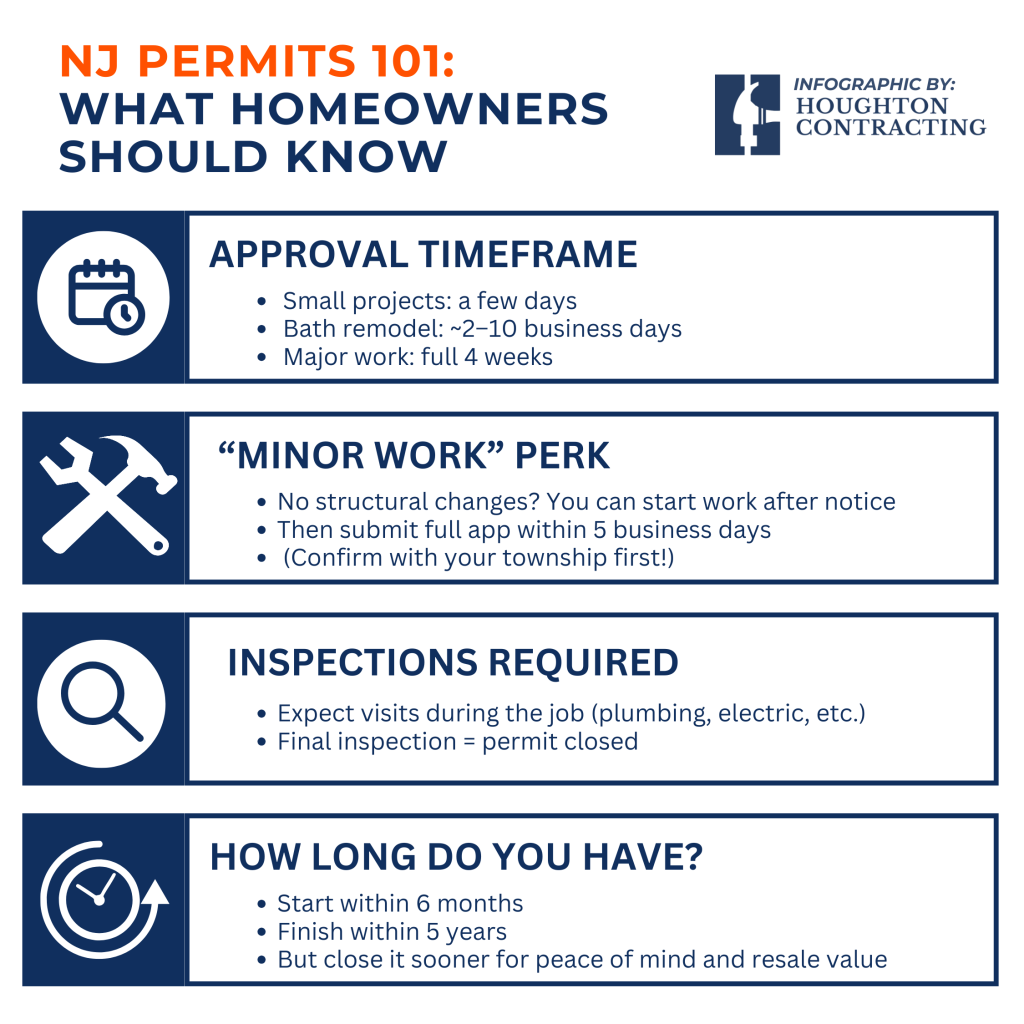
Once you determine a permit is needed, what's the process? In New Jersey, you (or your contractor) must apply for a construction permit through your local municipal building department (often called the Division of Inspections or Construction Office). Mercer County doesn't issue permits at the county level; it's handled by each town's code officials. For a bathroom remodel, you'll typically submit a construction permit application along with specific technical subcode forms for building, electrical, and plumbing work as applicable.
Submit your application to the township's construction office and pay the required fee. Permit fees vary by municipality and are often calculated based on the cost or size of the project. For instance, Hamilton's fee schedule roughly charges about $30 per $1,000 of project cost, with a $50 minimum. (Each sub-permit like plumbing or electrical may have its own fee; in Millburn, they note you pay separate fees for each trade permit needed.) Once your application is in, the code officials will review your plans for compliance with building codes.
Why You Shouldn't Skip the Permit, Legal & Financial Risks
It might be tempting to avoid the paperwork and fees by not pulling a permit, but doing so can lead to serious legal and financial consequences. First and foremost, performing work without a required permit is illegal. If the township finds out (either by a complaint or when an inspector sees unpermitted work), you could face steep fines. New Jersey's regulations allow penalties of up to $2,000 for each offense of failing to get a permit. Some towns even assess fines per day until you resolve the violation.
Even if the town doesn't catch you immediately, unpermitted work can come back to haunt you later. When you eventually sell your home, the buyer's inspection or a municipal records search can reveal modifications made without permits. Many Mercer County towns require a Continuing Certificate of Occupancy (CCO) or similar inspection on resale, which can flag illegal alterations. At that point, you may be forced to obtain a retroactive permit (sometimes called a "legalization" permit) for the old work before you can close the sale.
This process typically requires opening up finished walls or ceilings for inspection and getting everything up to current code, plus paying the permit fees, often with added penalty fees for late filing. As an example, one New Jersey town advises sellers who failed to get permits to contact the building department ASAP, because a retroactive permit will need the same fees and inspections as a normal one and can take several weeks to process, delaying a sale. In short, skipping a $100–$300 permit now could stall your $300,000 home sale later.
Furthermore, doing unpermitted work can void your homeowner's insurance in some cases. If a fire or flood is caused by work that was done without permits or inspections, an insurer might use that as grounds to deny your claim.
Conclusion
Finally, remember why permits exist. They're not just red tape; they ensure your remodel meets building safety standards. New Jersey requires permits "to protect public health, safety, and welfare". When you follow the rules, you get the benefit of professional inspections at key stages of the project, which can catch mistakes or hazards you might not see. This quality control can save you from future problems and give you peace of mind that your new bathroom is safe and up to code. As one town's building department puts it, getting a permit brings you the services of inspectors who approve each phase of construction, making sure the work is done safely and properly.
Bottom Line: In Mercer County, virtually any bathroom remodel beyond simple cosmetic updates will require a permit. This includes Hamilton Township and all neighboring communities, they all follow New Jersey's uniform code. If your project is purely surface-level (paint, re-caulk, replacing a faucet in the same spot), you're likely fine without one. But the moment you start moving plumbing, adding electrical, or altering structures, get that permit.
The application process is a manageable part of a remodel's timeline (often just a week or two for approval), and the cost is minor compared to the potential fines and headaches of doing work on the sly.
Don't Let Permits Slow You Down
We manage the paperwork and the transformation.
Start your bathroom remodel today → See Our Bathroom Renovation Services
FAQs
What happens if I remodel my bathroom without a permit in NJ?
You could face fines, forced removal of work, or issues when selling your home due to code violations.
How much does a bathroom remodel permit cost in NJ?
Permit costs vary by township but typically range from $100 to $500 depending on the scope and type of work.
How long does it take to get a bathroom remodel permit in NJ?
It can take 1 to 4 weeks, depending on municipal workload, completeness of plans, and type of remodel.
Do cosmetic updates like painting or replacing fixtures require a permit in NJ?
No, purely cosmetic changes like painting, tiling, or swapping out faucets typically don't require a permit.
Who pulls the permit for a bathroom remodel in New Jersey, the homeowner or contractor?
Either can pull the permit, but if a licensed contractor is doing the work, they usually handle it. Homeowners acting as their own general contractor may need to sign an affidavit.

/primary%20bathroom%20double%20vanity%20with%20backlit%20mirrors%20and%20glass%20shower%20in%20a%20houghton%20contracting%20custom%20home%20project%20in%20trenton%20new%20jersey.jpg?width=352&name=primary%20bathroom%20double%20vanity%20with%20backlit%20mirrors%20and%20glass%20shower%20in%20a%20houghton%20contracting%20custom%20home%20project%20in%20trenton%20new%20jersey.jpg)
/primary%20bathroom%20with%20glass%20shower%20and%20dark%20tile%20accent%20wall%20in%20a%20houghton%20contracting%20custom%20home%20project%20in%20trenton%20new%20jersey.jpg?width=352&name=primary%20bathroom%20with%20glass%20shower%20and%20dark%20tile%20accent%20wall%20in%20a%20houghton%20contracting%20custom%20home%20project%20in%20trenton%20new%20jersey.jpg)